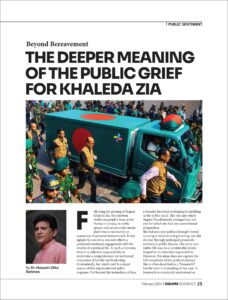

Beyond Bereavement: The Deeper Meaning of the Public Grief for Khaleda Zia
Hossain Zillur Rahman
Following the passing of Begum Khaleda Zia, the emotion visible on people’s faces at her Namaz-e-Janaza, in public spaces, and across social media platforms is not merely an expression of personal bereavement. It also signals the end of an era and reflects a profound emotional engagement with the totality of a political life. At such a moment, there is a collective responsibility to undertake a comprehensive yet restrained evaluation of her life and leadership.
Undoubtedly, her death itself is a major source of this unprecedented public response. Yet beyond the immediacy of loss, a broader historical reckoning is unfolding in the public mind. The role into which Begum Zia ultimately emerged was not one for which she had any conventional preparation.
She did not enter politics through formal training or institutional grooming, nor did she rise through prolonged grassroots activism in public forums. Her entry into public life was, to a considerable extent, shaped by an inherited responsibility. However, this alone does not capture the full complexity of her political journey.
She is often described as a “housewife”, but the term is misleading in her case. A housewife is commonly understood as someone with little or no public engagement. Khaleda Zia was not such a person. As the spouse of President Ziaur Rahman, she experienced public life at close quarters. She personally endured the trauma of internal displacement during the Liberation War of 1971, witnessed the tumultuous political landscape of that period, and lived through the turbulence of 1975 and the uncertainty surrounding November 7 and the future direction of the state. Following the assassination of President Zia in 1981, she was widowed. These experiences afforded her an unusually intimate perspective on state power and political change.
Even so, Khaleda Zia’s ascent to political and state leadership was neither easy nor inevitable. Power was not handed to her. Rather, it was her uncompromising stance during the anti-Ershad movement for the restoration of democracy that elevated her to national political leadership and ultimately to the leadership of the state. This was her own achievement. While her political journey may have begun with inherited responsibility, her ability to assert and consolidate that responsibility in the public arena testified to her personal resolve and capacity.
A key element in any balanced assessment of Khaleda Zia is her success in establishing herself as a political and state leader without formal institutional preparation. This must be acknowledged as a personal accomplishment and helps explain her enduring place in the public imagination.
Another defining dimension of her life was the succession of personal tragedies she endured over an extended period. The experience of internal displacement in 1971, the assassination of her husband, imprisonment and repression during the anti-autocracy movement, and what many perceived as unjust suffering imposed on her during the last decade and a half combined to generate deep public sympathy. In our society, compassion for those who suffer unjustly is a powerful moral instinct, and Khaleda Zia became a recipient of that compassion precisely because her suffering was widely viewed as undeserved.
In evaluating Khaleda Zia’s role as a state leader, three areas merit particular emphasis.
First, her consistent opposition to hegemonic dominance. Especially in relation to questions of regional hegemony, her position was clear, firm and sustained. This stance was not shaped by tactical opportunism or short-term strategic calculation; rather, it was articulated openly as a matter of principle in defence of Bangladesh’s national interest. This consistency stands as a notable achievement of her state leadership.
Second, her role in economic transformation deserves careful attention. While the expansion of the private sector and the market economy in Bangladesh began in the 1970s and 1980s, it gained decisive momentum in the early 1990s during her tenure. The institutional foundations for private banking, private universities and wider private-sector growth were largely laid during this period. Notably, she never claimed exclusive credit for these developments. She did not project herself as a technical expert in public discourse; rather, she emphasised consultation and collective decision-making. She accorded due respect and authority to finance ministers such as Saifur Rahman. In contrast to the highly centralised and overtly
authoritarian decision-making patterns witnessed in more recent times, the collegial culture of governance during her tenure stands out as a positive counterpoint.
Third, her contribution to women’s empowerment constitutes another important dimension of her legacy. Shaped, in part, by her own life experiences, she demonstrated a clear sensitivity to this issue. In the early 1990s, initiatives such as the girls’ stipend programme, Food for Education, and conditional cash transfer schemes played a pivotal role in expanding female education and enhancing women’s empowerment. In subsequent years, international organisations, including the World Bank, recognised these programmes as innovative and effective social safety net interventions.
Khaleda Zia also made a distinctive contribution to political culture. Despite prolonged suffering, sustained provocation and intense pressure, she generally maintained restraint in her public speech. She consciously avoided personal attacks and abusive language. Grace under pressure — the ability to preserve composure and dignity under extreme strain — is rare in Bangladesh’s political landscape. This quality remains an enduring part of her legacy.
Begum Khaleda Zia leaves behind her party, the Bangladesh Nationalist Party (BNP), in a unified organisational and leadership structure. Yet to assess her solely through a partisan lens would be incomplete. Her individual achievements in political and state leadership, her moral positioning, her decision-making style, and her restraint within political culture together offer important lessons for the country’s future leadership. In the aftermath of her passing, it is incumbent upon us to move beyond emotion and engage in such a comprehensive evaluation, drawing from it the lessons that truly matter.