Courage in Captivity: Khaleda Zia’s Life of Struggle and Devotion
Shafiq Rehman
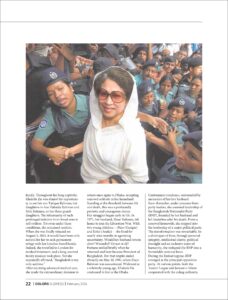
Khaleda Zia is often described as an uncompromising leader. She certainly was. Yet a more precise and just characterisation would be to describe her as a courageous leader defined by struggle. Her life bears testimony to this: she refused to compromise even in the face of death itself.
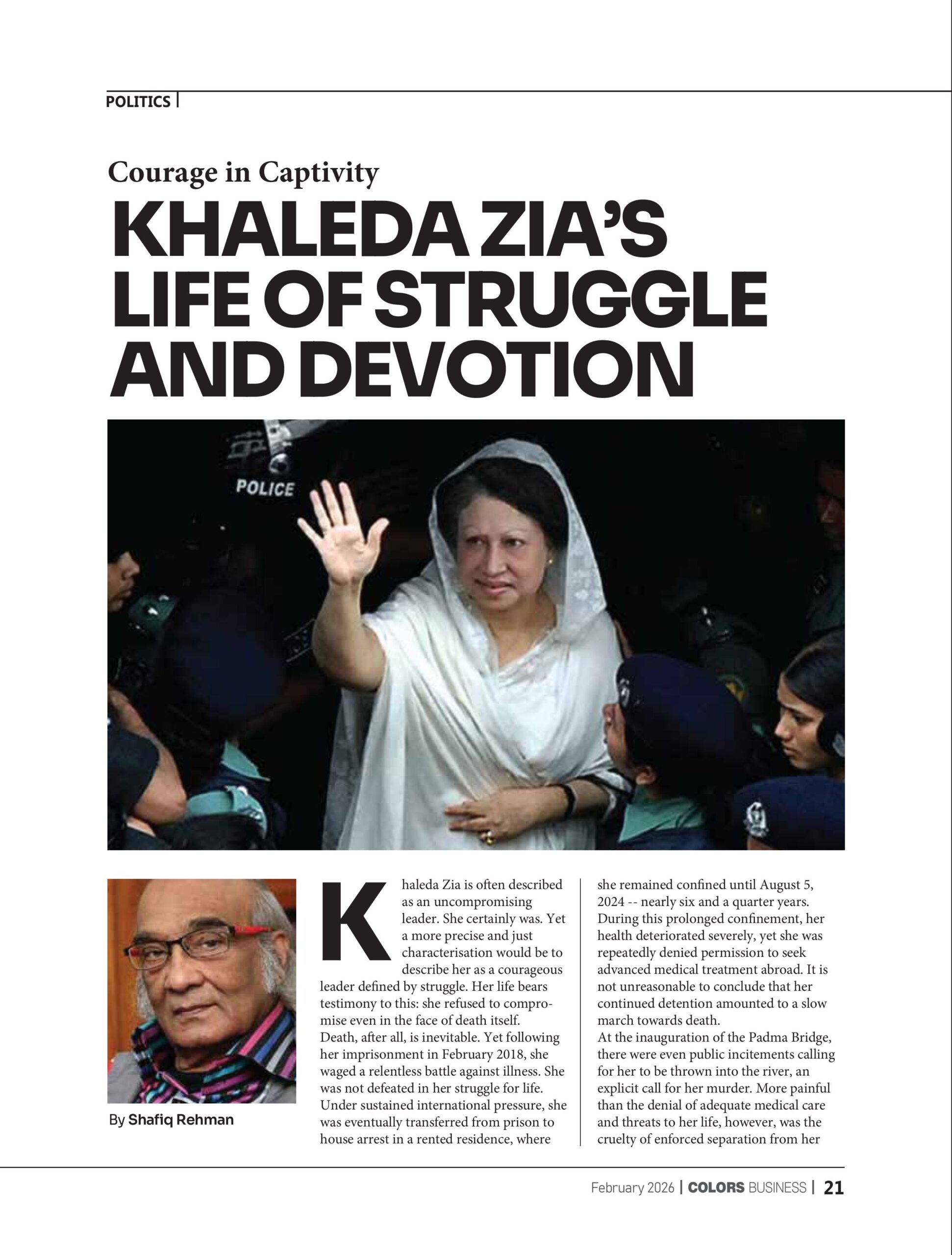
Death, after all, is inevitable. Yet following her imprisonment in February 2018, she waged a relentless battle against illness. She was not defeated in her struggle for life. Under sustained international pressure, she was eventually transferred from prison to house arrest in a rented residence, where she remained confined until August 5, 2024 — nearly six and a quarter years.
During this prolonged confinement, her health deteriorated severely, yet she was repeatedly denied permission to seek advanced medical treatment abroad. It is not unreasonable to conclude that her continued detention amounted to a slow march towards death.
At the inauguration of the Padma Bridge, there were even public incitements calling for her to be thrown into the river, an explicit call for her murder. More painful than the denial of adequate medical care and threats to her life, however, was the cruelty of enforced separation from her family. Throughout her long captivity, Khaleda Zia was denied the opportunity to see her son Tarique Rahman, her daughters-in-law Zubaida Rahman and Sithi Rahman, or her three granddaughters. The inhumanity of such prolonged isolation from loved ones is self-evident. Yet even under these conditions, she remained resolute.
When she was finally released on August 5, 2024, it would have been only natural for her to seek permanent refuge with her London-based family. Indeed, she travelled to London for medical treatment, and a long-awaited family reunion took place. Yet she repeatedly affirmed, “Bangladesh is my only address.”
After receiving advanced medical care, she made the extraordinary decision to return once again to Dhaka, accepting renewed solitude in her homeland. Standing at the threshold between life and death, this was a profoundly patriotic and courageous choice.
Her struggles began early in life. In 1971, her husband, Ziaur Rahman, left home to join the Liberation War. With two young children — Pino (Tarique) and Koko (Arafat) — she lived for nearly nine months in agonising uncertainty. Would her husband return alive? Wounded? Or not at all?
Fortune smiled briefly when he returned and later became President of Bangladesh. But that respite ended abruptly on May 30, 1981, when Ziaur Rahman was assassinated. Widowed at a relatively young age, Khaleda Zia continued to live in the Dhaka Cantonment residence, surrounded by memories of her late husband.
Soon thereafter, under pressure from party leaders, she assumed leadership of the Bangladesh Nationalist Party (BNP), founded by her husband and left leaderless after his death. From a reserved housewife, she stepped into the leadership of a major political party. The transformation was remarkable. In a short span of time, through personal integrity, intellectual clarity, political foresight and an inclusive sense of humanity, she reshaped the BNP into a formidable national force.
During the Ershad regime, BNP emerged as the principal opposition party. At various points, both the Awami League and Jamaat-e-Islami cooperated with the ruling authority. BNP’s uncompromising stance, however, ultimately prevailed. Following the fall of Ershad in December 1990, the general election held in 1991 under President Shahabuddin Ahmed’s interim government resulted in a decisive BNP victory.
Khaleda Zia thus became the first woman Prime Minister of Bangladesh. Many now acknowledge that the period from 1991 to 1996 under her leadership represented one of the country’s finest eras. Corruption was restrained, freedom of expression flourished, and the prices of essential commodities remained within the reach of ordinary citizens.
During this time, she bestowed upon Bangladesh one of its most enduring democratic gifts: free and fair general elections held every five years under a caretaker government. Two consecutive elections were conducted under this system. There is a critical distinction to be drawn here. President Ziaur Rahman introduced multi-party democracy while remaining in power. Khaleda Zia, by contrast, enacted the
caretaker government law, relinquished office, and contested elections on an equal footing with all political rivals.
This, too, was an act of courage and of struggle in service of the republic.
In the 1996 election, the Awami League formed an alliance with Jamaat-e-Islami. Although that coalition emerged victorious, the BNP secured 116 seats, becoming the largest opposition party in Bangladesh’s history. Rather than levelling frivolous allegations of “gross rigging” or “subtle manipulation,” Khaleda Zia focused on preparing her party for victory in the 2001 election. Neither she nor her party resorted to violence, indecency, or electoral malpractice. Their commitment to peaceful political conduct was rewarded in October 2001, when the BNP was elected to power once again.
However, even after returning to government, Khaleda Zia confronted new challenges. In 2004, following the United States’ declaration of war on Iraq, Washington sought Bangladesh’s military support. Anticipating her refusal, President George W Bush’s administration dispatched Defence Secretary Donald Rumsfeld and Secretary of State Colin Powell to Dhaka to persuade her. Khaleda Zia stood firm and declined the request, a decision that, from that moment, made her eventual removal from power all but inevitable.
When I asked her why she had rejected the American proposal, she replied, “I understand the pain of widows. I do not want any woman in my country to suffer that pain.”
On 11 January 2007, a military-backed coup occurred in Bangladesh. This manoeuvre weakened the BNP while strengthening the Awami League, ultimately paving the way for the AL’s victory in the December 2008 election. The greatest damage from that period, however, came when, at the Awami League government’s behest, a compliant judge abolished the caretaker government system. This set in motion nearly fifteen years of Awami misrule without free and fair elections.
Today, the nation’s hope lies in the restoration and careful preservation of the caretaker government system, the most precious democratic gift Khaleda Zia bequeathed to the people.
It must be remembered that Khaleda Zia’s life of struggle was long and arduous. Widowed prematurely in 1981, she endured multiple forms of repression during the Ershad era, was confined to sub-jail life under General Moeen U Ahmed, forcibly evicted from a home steeped in decades of personal memories during Awami misrule, and finally separated from her family during imprisonment from 2018 to 2024.
Throughout these trials, she remained remarkably resolute. She never wavered from her principles or ideals, and she never sought votes through empty promises. Pure integrity and unceasing struggle, this is the true essence of Khaleda Zia.
As the American Civil Liberties movement once declared, “Liberty is always an unfinished business.” Bangladesh is no exception.
The July 2024 movement was an anti-discrimination movement. I believe that if regular general elections are held under a caretaker government, the struggle for liberation will continue, and ordinary people will eventually be freed from poverty and unemployment. Achieving this will be the truest tribute to Khaleda Zia.
You were in Bangladesh, you are in Bangladesh, and you will remain in Bangladesh. This is your only address. Rest in peace. Farewell, Madam Khaleda Zia.