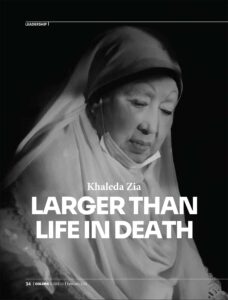

Khaleda Zia: Larger Than Life in Death
Hasan Ferdous
Bangladesh did not expect to rediscover hope in death. After Sheikh Hasina’s dramatic fall from power in August 2024, the country briefly believed it had escaped the grip of history. Young people flooded the streets with slogans of renewal; the future appeared open, negotiable, even generous. That optimism, however, proved short-lived. Factionalism returned. Old politicians resurfaced. The familiar scramble for power resumed, leaving behind a deeper cynicism than before.
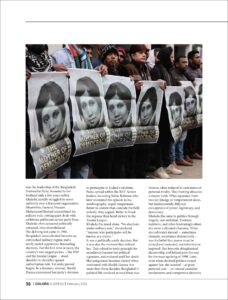
Then, as 2025 drew to a close, an unlikely figure reclaimed the national imagination. Khaleda Zia — frail, politically marginalised, and nearing eighty — died. What followed stunned even her critics. Millions poured into the streets to mourn her. In death, a leader long dismissed as accidental or obsolete became something larger: a moral reference point in a moment of collective exhaustion.
Bangladesh, desperate for coherence, discovered that it was grieving not merely a person, but the idea that power could still be refused.
Khaleda Zia’s political journey defied convention. Widowed in her mid-30s after the assassination of President Ziaur Rahman in 1981, she entered politics as a novice. Even her detractors concede that her ascent was improbable. Yet over time, those same critics, who once mocked her as a housewife elevated by marriage and circumstance, came to describe her with a phrase rarely granted in Bangladeshi politics: a leader of uncompromising principle.
That quality revealed itself early. Thrust into the leadership of the Bangladesh Nationalist Party, founded by her husband only a few years earlier, Khaleda initially struggled to assert authority over a fractured organisation. Meanwhile, General Hussain Muhammad Ershad consolidated his military rule, cutting quiet deals with ambitious politicians across party lines. Khaleda often appeared politically cornered, even overwhelmed.
The defining test came in 1986. Bangladesh stood divided between an entrenched military regime and a newly united opposition demanding elections. For the first time in years, the country’s two largest parties — the BNP and the Awami League — stood shoulder to shoulder against authoritarian rule. Yet unity proved fragile. In a dramatic reversal, Sheikh Hasina announced her party’s decision to participate in Ershad’s elections.
Panic spread within the BNP. Senior leaders, including Saifur Rahman who later recounted the episode in his autobiography, urged compromise. Better to contest than concede the field entirely, they argued. Better to break the impasse than hand victory to the Awami League.
Khaleda Zia stood alone. “No elections under military rule,” she declared. “Anyone who participates will be known as a traitor.”
It was a politically costly decision. But it was also the moment that defined her. That refusal to trade principle for expediency became her political signature, and endured until her death.
Her uniqueness becomes clearer when contrasted with Sheikh Hasina. For more than three decades, Bangladesh’s political life revolved around these two women, often reduced to caricatures of personal rivalry. That framing obscures a deeper truth. What separated them was not lineage or temperament alone, but fundamentally different conceptions of power, legitimacy, and democracy.
Khaleda Zia came to politics through tragedy, not ambition. Taciturn, stubborn, and often frustratingly silent, she never cultivated charisma. What she cultivated instead — sometimes clumsily, sometimes destructively — was the belief that power must be earned and contested, not inherited or imposed. Her boycotts delegitimised dictatorship and helped pave the way for the mass uprising of 1990. Later, even when electoral politics turned against her, she insisted — at great personal cost — on neutral caretaker mechanisms and competitive elections. She accepted alternation of power as a democratic necessity, not a betrayal.
Sheikh Hasina’s relationship with power evolved in the opposite direction. Scarred by exile and repeated assassination attempts, she came to view power as existential, something that had to be held at all costs to
protect the state, her party, and her version of history. Stability justified coercion; dissent became subversion.
Under Hasina, Bangladesh recorded economic growth and infrastructure expansion. Yet, the price was the steady hollowing out of democratic institutions. Elections continued, but competition narrowed. Courts functioned, but selectively. Media survived, but under pressure. The opposition was not merely defeated; it was delegitimised and criminalised.
Here lies the sharpest contrast. Khaleda Zia treated opposition as adversarial but legitimate. Sheikh Hasina came to treat opposition as an existential threat to the state itself.
Bangladesh now struggles to imagine politics without either woman. Their lives offer a cautionary lesson. Khaleda believed democracy was messy, inefficient, and often unfair, but indispensable. Hasina came to believe democracy was dangerous unless tightly managed. One accepted uncertainty as the price of freedom. The other sought finality in the name of order.
History may judge Khaleda Zia not by her achievements in office, but by her refusal to absolutise power. In a country increasingly allergic to dissent, that refusal — more than any policy or election — may prove her most enduring legacy.